The Human Advantage in the Age of Algorithms
This is a prose version of my speaker’s notes for a keynote delivered at Maven Insights’ 8th Annual People Analytics Forum in Riyadh, Saudi Arabia, on November 19, 2025.
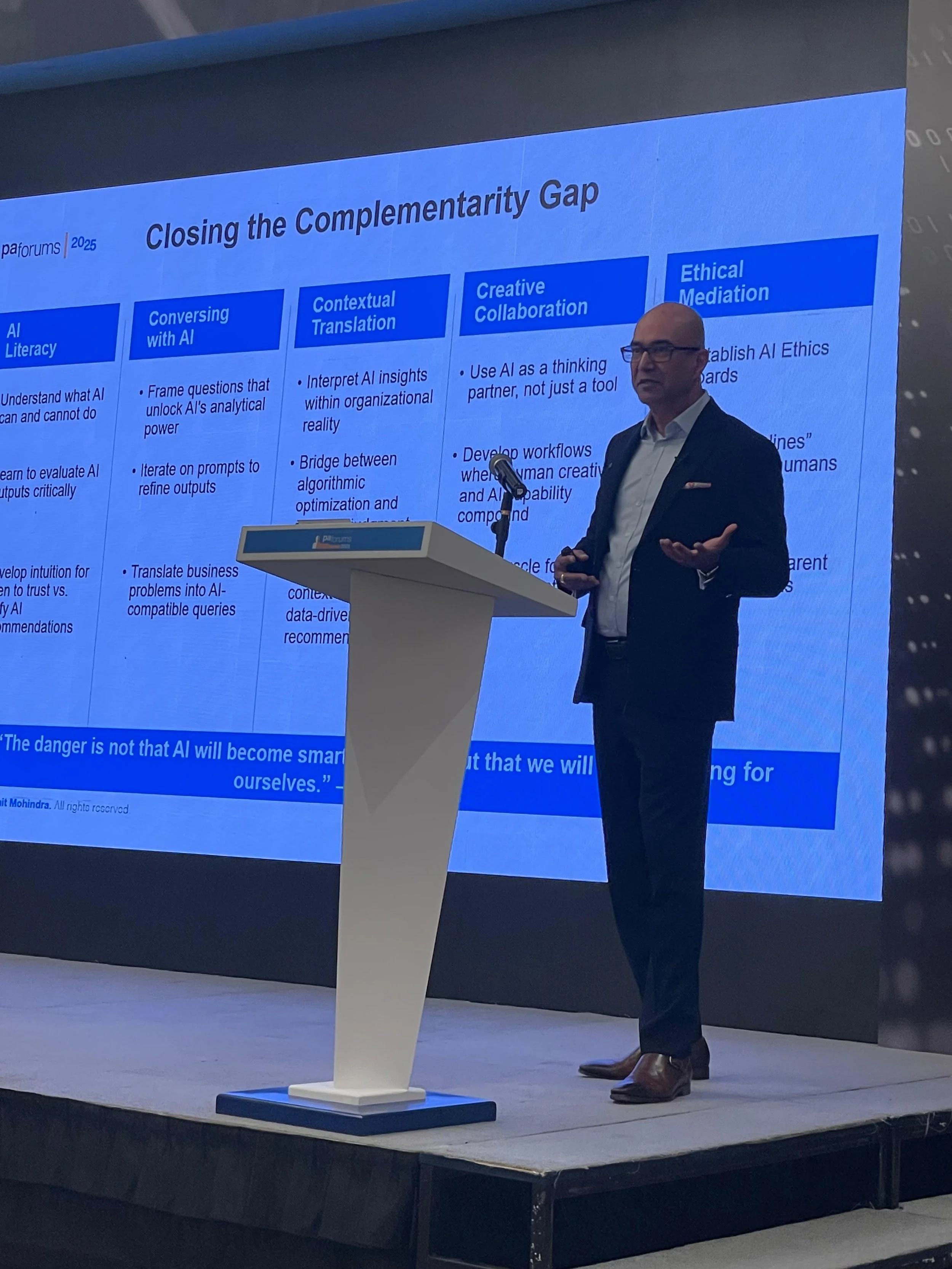
Standing on a stage in Riyadh recently, I felt a powerful sense of history blending with the future. Riyadh, a historic crossroads for trade and culture, hosted Maven Insights’ eighth annual People Analytics Forum, drawing leaders from Saudi Arabia and nearby countries to rethink employability in the Age of Artificial Intelligence. I was there to deliver a keynote titled The Human Advantage in the Age of Algorithms.
I chose the specific phrasing "Age of Algorithms" deliberately. We often forget that the word algorithm is not a modern Silicon Valley invention. It has an Arabic root, like words such as algebra, average, and azimuth, reflecting the Arab world’s early dominance in math and science. Scholars of that age helped lay the mathematical foundations that now shape our digital lives. Today, that legacy of advanced thinking is reflected in Saudi Arabia’s Vision 2030, specifically in its Human Capability Development Program.
What struck me most about Vision 2030 wasn't the focus on technology investment; it was the emphasis on people investment. The program explicitly aims to instill values, develop basic and future skills, and enhance knowledge, recognizing that true digital transformation is a blueprint for lifelong employability. It understands a fundamental truth that often gets lost in the noise of hype cycles: developing human capability is the only way to keep a workforce future-ready and a nation future-proof.
I’ve been working with AI for many years and launched The Conference Board’s Intelligent Automation Executives Council in 2019 to help organizations leverage AI beyond just robotic process automation. My keynote at the 2024 PA Forum, titled HR and People Analytics: The Keys to Organizations’ Adoption of AI, encouraged HR leaders to take the lead in adopting AI within their organizations and included a gentle introduction to AI to make the “black box” of AI more understandable.
Despite my AI experience and perspective, I am humbled every day by how much more there is to keep up with and learn. Conversations around AI are pervasive, relentless, and overwhelming. The technology advances faster than we can master, forcing us to ask the uncomfortable question: Is there room for us? Where do we fit in? The answer is an emphatic yes—but only if we are bold enough to claim our place.
The Mirror of Technology
To understand our place in the Age of Algorithms, we need to change how we view AI. Technology acts as a mirror. AI isn’t just another device; it reflects our values, our way of learning, and how we lead. When I started my own journey, shifting from the precision of electrical engineering to the messy world of labor economics—where the focus is on people rather than circuits, chips, and algorithms—I still believed that many talent-related challenges within an organization were technical. It was just a matter of gathering the relevant data, performing the right analysis, and implementing the obvious solution.
We now live in a time when AI can process information at speeds we cannot comprehend, but it cannot understand the information. AI can detect patterns with superhuman accuracy, but it cannot discern purpose behind the pattern. It can optimize decisions based on any variable we specify, but it does not know what better actually means.
René Descartes famously declared, "I think, therefore I am." Today, machines also "think"—they compute, simulate, and learn. But the question is no longer “Who can think faster?” It is “Who can think deeper? That remains profoundly human work and involves judgment, empathy, and ethics.
The question is no longer whether AI will transform jobs. That ship has sailed. The World Economic Forum’s Future of Jobs Report estimates that while 78 million jobs may be displaced, there is a net positive outlook, though the skills gap is widening. The question is how businesses and individuals will adapt to thrive alongside intelligent machines. We must move from asking "What can AI do?" to "How do humans and AI grow together?"
The Human Advantage: Context, Empathy, and Intent
Economists have long discussed "comparative advantage"—the idea that countries or organizations should focus on what they do best relative to others. In the Age of Algorithms, our comparative advantage is not calculation. It is our context, our empathy, and our intent.
Consider the difference: AI can identify correlation; people can perceive meaning. AI can predict turnover; humans can prevent it. AI can detect sentiment; humans can change it. This is the "Human Advantage." It is a competitive edge: the ability to create valuable, unique, and hard-to-imitate products. It embodies creativity, compassion, and judgment in a world of perfect calculation.
The real opportunity lies in human-AI complementarity, where machine logic meets human wisdom, enabling innovation to be both efficient and ethical. Algorithms amplify human creativity by processing vast datasets, generating variations, and handling computationally intensive tasks. Humans amplify algorithms by asking better questions, interpreting results, and defining what success means. When we combine these intelligences wisely, we amplify both; when we don’t, we create a gap.
A complementarity gap arises when human and machine strengths are misaligned—when we naively pursue automation for its own sake or ignore the development of human capabilities. Closing this gap requires deliberate steps: AI literacy, the ability to "converse" with models, and the wisdom to create workflows that combine human creativity with machine accuracy. When humans and AI work together effectively, value increases; when they compete, value drops.
Redefining Value: From Efficiency to Capability
For decades, the corporate world considered value as efficiency—producing more output with less input. On a broader scale, we measured gross domestic product, not imagination. We treasured human capital. But stockpiled knowledge decays rapidly. The shelf-life of technical skills is getting shorter every day.
The new frontier of value is capability. Unlike static skills or efficiency metrics, human capability appreciates over time. It grows through experience, collaboration, and reflection. If we want to succeed, our measurement systems must evolve. If we focus on efficiency, we will only optimize output. If we focus on capability, we will start optimizing growth.
Human Capabilities
During the conference, I outlined five core human capabilities that will define employability in the Age of Algorithms. These are not just "soft skills.” They are the hard currency of the future.
Adaptability: The Skill of All Skills
Adaptability forms the base of all the other capabilities. It is the capacity to adjust when tools, goals, or circumstances shift. It combines cognitive flexibility, emotional resilience, and a desire to learn. The World Economic Forum includes adaptability—resilience, flexibility, and agility—as a skill on the rise for the rest of the decade. Adaptable individuals don’t oppose change; they reorganize around it. We are heading toward a future where measuring an "Adaptability Quotient" (AQ) will be as important as IQ and EQ. This isn't just about learning new software; it's about the psychological readiness to unlearn old habits and face the unknown. When adaptability is multiplied by collaboration, innovation accelerates.
Collaboration Quality: The Multiplier of Collective Intelligence
When we talk about the Future of Work, we often focus on collaboration tools like Zoom, Slack, and Teams. But the true differentiator isn’t the platform or the number of meetings; it’s the quality of collaboration that occurs outside the platform and between meetings. It’s about the trust and shared purpose within meetings. Genuine collaboration determines whether intelligence becomes collective or stays fragmented. It flourishes when leaders create psychological safety, enabling learning to speed up and innovation to grow. We should view collaboration not as a series of transactions but as an overall measure of trust, diversity, and clarity. Collaboration quality sets the stage for something extraordinary—the spark of imagination that only creativity can provide.
Creativity: From Intelligence to Imagination
Creativity is humanity’s oldest renewable resource. It enables us to move from what is to what could be. Algorithms are designed to improve existing things; imagination invents what doesn’t yet exist. AI can generate content, but humans assign it meaning. AI can remix, but it cannot dream. Successful organizations will treat imagination as a measurable business asset. We should ask: what is our "Return on Imagination"? How much of our creative energy creates new value, customer delight, or cultural resonance? But creativity without critical thinking can lose direction.
Critical Thinking: The Compass of Judgment
The American Philosophical Association defines critical thinking as "purposeful, self-regulatory judgment which results in interpretation, analysis, evaluation, and inference." In the Age of Algorithms, critical thinking serves as the guiding compass. AI provides answers; critical thinking ensures we ask the right questions. AI produces probabilities; humans offer judgment. In an environment driven by algorithms, critical thinking is our only protection against automation bias, the tendency to over-rely on automated tools and ignore conflicting information, even when humans are correct. We must actively develop the skepticism needed to challenge the algorithms within the "black box."
Learning Agility: The Engine of Adaptation
If adaptability helps us pivot, learning agility fuels the journey. It is the ability and motivation to quickly and continually learn from experience and apply it to new situations. People with high learning agility respond to the unknown not with resistance, but with curiosity and humility. Research by Korn Ferry has found that learning agility is a better predictor of leadership success than raw intelligence or tenure. Their model breaks this down into mental agility, people agility, change agility, and results agility. These are the traits that define who can navigate the "first-time" situations that AI cannot solve.
The End of Jobs and the Rise of Fluid Work
If employability is now defined by this portfolio of capabilities, then the very structure of work must change. The "job" as a fixed container of tasks was built for a different era. AI dissolves rigid boundaries. Tasks fragment, skills recombine, and jobs become dynamic portfolios of contribution.
We are moving toward work ecosystems that organize talent around emerging problems instead of static hierarchies. This shift frees employees from fixed roles, creating "work liquidity" across functions and regions. It shifts the focus from "filling a role" to "solving a problem."
This is where People Analytics becomes the essential guide. It’s no longer just about democratizing dashboards; it’s about organizational sensemaking. As organizational theorist Karl Weick explained, sensemaking is the process through which we structure the unknown to make it understandable. In the Age of Algorithms, People Analytics must fulfill three strategic roles: as the nervous system, translating signals from every part of the organization into actionable insight; as the conscience, measuring what truly matters and communicating those priorities throughout the culture; and as the super-interpreter, ensuring humans remain in the decision-making loop.
Leadership: From Transformational to Adaptive
Finally, this shift demands a new kind of leadership. For years, we have celebrated Transformational Leadership, where a visionary leader inspires and motivates followers with a compelling vision and a clear path forward. But that model assumes the leader already knows the right direction.
Today’s challenges are not technical; they are adaptive. Technical challenges can be solved with existing know-how, but adaptive challenges require changes in values, beliefs, and behaviors. In adaptive challenges, neither the problem nor the solutions are knowable in advance. This calls for adaptive leadership, a framework developed by Ron Heifetz, which mobilizes people to tackle tough challenges and learn their way through uncertainty together. It requires humility, curiosity, and courage.
The stance shifts from "follow me—I have the answer" to "let’s explore together—I’ll hold the space while we experiment." We move from hero to host, from command-and-control to sense-and-respond, or in the words of Satya Nadella, from a know-it-all organization to a learn-it-all organization. An adaptive leader regulates the "productive distress" in the system, keeping the heat high enough to motivate change but low enough to prevent panic. Adaptive leaders enable the organization to learn faster than the technology evolves.
The Human Advantage Manifesto
This brings us to the core of our challenge. It is not enough to understand these concepts intellectually; we must embody them. I ended my time in Riyadh with a specific call to action, a "Human Advantage Manifesto." It is a series of commitments we must make to ourselves and our organizations to ensure we do not just survive the Age of Algorithms but shape it. I present these ten principles here not as a checklist, but as a roadmap for personal and professional renewal.
Our primary responsibility is to master the tool, not be controlled by it. We need to attain true AI literacy, moving beyond headlines to understand how models actually work. We can't effectively collaborate with a technology we see as magic; we must demystify the "black box" so we can govern it. Once we grasp the mechanics, we must learn to converse intelligently. The art of the future isn’t just finding answers but asking better questions. We should treat our interaction with AI as a dialogue, where human questions refine machine output, and machine output prompts deeper human inquiry.
This intellectual shift must be matched by a commitment to apply context relentlessly. AI operates in a sea of data; humans operate in the rich, messy world of context. We must be the bridge that connects abstract probabilities to the specific, nuanced reality of our business environment. To do this well, we must design for complementarity. We must become architects of workflows where human imagination meets machine precision. We must stop asking which tasks can be automated and start asking how human and machine capabilities can be woven together to achieve what neither could do alone.
However, structure without soul is empty. We must elevate our conversations. In every team meeting, we need to shift the focus from "how fast can we do this?" to "why are we doing this?" We must prioritize depth over speed, for speed is now a commodity, while depth is a luxury. This requires us to champion emotional capital. We must make it our mission to spot and nurture moments of genuine human connection, creating the psychological safety that allows innovation to flourish. In a world of synthetic interactions, authentic human connection becomes the premium asset.
To sustain this, we must measure what matters. If we continue to measure only efficiency, we will optimize ourselves into obsolescence. We must design new metrics that track the growth of human capability, the quality of collaboration, and the return on imagination. But measurement must be guided by values, so we must also act as the organization’s conscience. We must ensure that technology serves our ethics, not the other way around. We are the guardians of the moral direction of our organizations, a role no algorithm can ever fill.
Finally, this requires a personal commitment to invest in our own irreplaceable value. We should dedicate at least one hour each week to developing a skill that makes us truly human—whether that is active listening, creative problem-solving, or ethical decision-making. We must treat our own capabilities as an appreciating asset. Ultimately, we must choose our agency. We need to decide today that we are not victims of disruption but partners in evolution. The future is not something that happens to us; it is something we create through the choices we make every day.
We stand at a threshold where the machine offers us the world, but it is our humanity that gives us the wisdom to know what to do with it; let us step forward not as users, but as leaders. In the end, the Age of Algorithms will not be remembered for the code we wrote, but for the human potential we unleashed when we finally stopped competing with machines and started believing in ourselves.
References
Facione, P. A. (1990). Critical thinking: A statement of expert consensus for purposes of educational assessment and instruction ("The Delphi Report"). The California Academic Press.
Government of Saudi Arabia (2016). Vision 2030: Kingdom of Saudi Arabia. https://www.vision2030.gov.sa/media/rc0b5oy1/saudi_vision203.pdf.
Heifetz, R. A. (1994). Leadership without easy answers. Belknap Press of Harvard University Press.
Hempel, J. (Host). (2020, September 7). Microsoft CEO Satya Nadella wants you to become a “learn-it-all” [Audio podcast episode]. In Hello Monday. LinkedIn. https://podcasts.apple.com/gb/podcast/microsoft-ceo-satya-nadella-wants-you-to-become-a/id1453893304?i=1000490314386.
Mohindra, A. B. (2025, November 19). The human advantage in the age of algorithms [Conference session]. Maven Insights 2025 People Analytics Forum, Riyadh, Saudi Arabia.
Mohindra, A. B. (2024, November 27). HR and people analytics: The keys to organizations’ adoption of AI. [Conference session]. Maven Insights 2024 People Analytics Forum, Riyadh, Saudi Arabia.
Newhall, S. (2014, August 19). Why “learning agility” is key to leadership success. IEDP Developing Leaders. Retrieved from https://www.iedp.com/articles/why-learning-agility-is-key-to-leadership-success/.
Weick, K. E. (1995). Sensemaking in organizations. Sage Publications.
World Economic Forum (2025). The future of jobs report 2025. World Economic Forum. https://www.weforum.org/publications/the-future-of-jobs-report-2025/in-full/.